
Building a Timetable for a Marketing Plan
A marketing plan can have a great strategy, a well-researched target market, and a strong budget, and still fail because nobody worked out when anything was supposed to happen. The timetable is the part of the plan that turns all those decisions into a schedule: who does what, and by when. Without it, a marketing plan is really just a list of good intentions.
It sounds like the boring administrative bit compared to strategy and creative work, and in a way it is. But it’s also one of the parts of the plan that decides whether everything else actually gets delivered.
What Is a Marketing Timetable?
At its simplest, a timetable lists every activity in the marketing plan, in order, with a start date, an end date, and usually who’s responsible for it. For a product launch, that might include market research, creative development, media bookings, PR outreach, the launch date itself, and follow-up promotions. For an ongoing campaign, it might be organized by month or quarter across the year.
Most marketers build this as a Gantt chart, a horizontal bar chart where each row is a task and the bars show when that task starts and finishes along a timeline. The format goes back to the American engineer Henry Gantt, who developed it in the early twentieth century as a way for factory supervisors to see at a glance whether work was on schedule, ahead of it, or behind it. It’s over a hundred years old at this point, and marketers still use basically the same idea, just usually in software like a spreadsheet or a project management tool rather than on paper.
Why Not Just List the Tasks Without Dates?
We could write a marketing plan that just says “we will run social media advertising, do a PR push, and launch a promotion,” without saying when. Plenty of plans, especially rough early drafts, look exactly like that.
The problem is that marketing activities depend on each other, and most of them depend on things outside marketing too. We can’t book media placements before the creative is finished. We can’t finish the creative before the messaging and positioning are agreed. We can’t agree the messaging before we know exactly what we’re launching and when the product itself will actually be ready. If any one of those slips, everything after it slips too, unless we’ve built in some slack.
A timetable forces us to think through that chain of dependency before we’re in the middle of it. If we know creative development takes six weeks and media needs to be booked four weeks before launch, we can work backward from a launch date and see whether our timeline is actually realistic, or whether we’re setting ourselves up to either rush the work or miss the date.
Working Through an Example
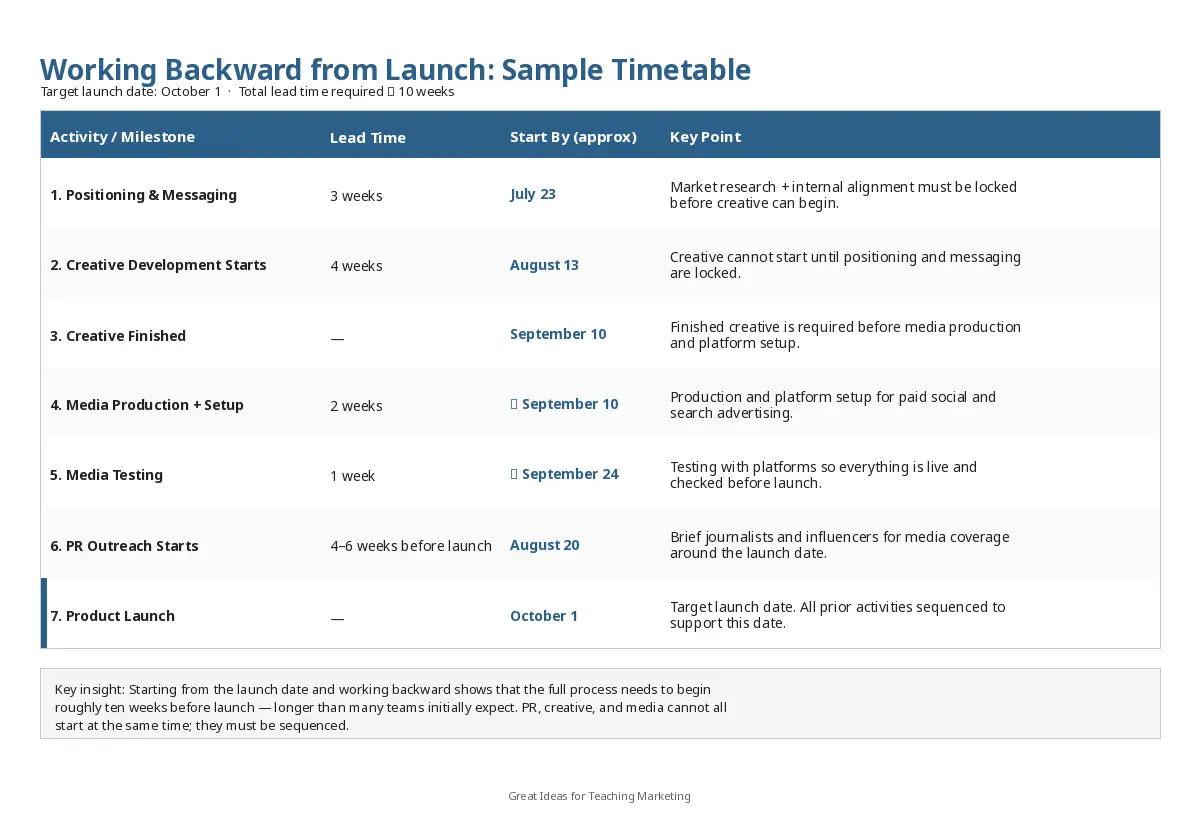
Let’s say we’re planning the launch of a new product with a target launch date of October 1.
Working backward, PR usually needs lead time. If we want media coverage around launch, we typically need to brief journalists and influencers four to six weeks ahead, so PR outreach needs to start by around August 20.
Paid media, say a mix of social and search advertising, usually needs the creative finished before it can go into production and testing with the platforms. If media production and setup takes two weeks and testing another week, and we want everything live and checked before launch, creative needs to be finished by around September 10, which means creative development, if it takes four weeks, needs to start around August 13.
And creative can’t really start until positioning and messaging are locked, which usually comes out of market research and internal alignment on what we’re actually saying about the product. If that takes three weeks, we need to start that process by around July 23.
Notice what happened there. We started with a launch date and worked backward, and it turns out the whole process needs to start roughly ten weeks before launch, not two or three. That’s a pretty common experience when people build a timetable properly for the first time: the amount of lead time required is usually longer than expected, especially once PR, creative, and media are all sequenced against each other rather than assumed to happen at the same time.
What About Things That Can Happen in Parallel?
Not everything in a timetable has to happen one after another. Market research and internal budget approval, for example, can often run at the same time rather than waiting on each other. A good timetable identifies which tasks are dependent (one can’t start until another finishes) and which are independent (they can run in parallel), because treating everything as sequential when it doesn’t need to be just makes the whole plan take longer than it has to.
This is really the main skill in building a timetable: figuring out the true dependencies, rather than just listing tasks in the order they occurred to us. Two tasks scheduled at the same time that don’t actually depend on each other is efficient. Two tasks scheduled at the same time that do depend on each other is usually a mistake that shows up later as a delay.
What Goes Wrong If the Timetable Is Unrealistic?
The most common problem is treating a timetable as aspirational rather than realistic. It’s tempting to write the schedule we’d like to have, with everything compressed to hit a launch date that was set for reasons that have nothing to do with how long the work actually takes, maybe a date tied to a trade show, a fiscal year end, or a promise made to a retail partner.
If the timetable doesn’t reflect how long things genuinely take, a few things tend to happen. Corners get cut on research or testing to save time. Teams end up working evenings and weekends to hit dates that were unrealistic from the start, which isn’t sustainable and tends to show up in the quality of the work. Or the launch date quietly slips anyway, except now it’s slipping in an uncoordinated way, with some parts of the business still working to the old date and others not.
There’s also a competitive angle worth thinking about. If a competitor is racing toward the same market opportunity, an unrealistic timetable that causes us to launch late, or to launch with weaker creative because everything was rushed, can cost us the advantage of being first or being polished, which in some categories matters a lot.
How Detailed Should a Timetable Actually Be?
This depends on the size of the plan. A small campaign might only need a dozen line items. A full annual marketing plan for a larger business might run to dozens of activities across every month, broken down by channel, product line, and region.
As a rough guide, each line in the timetable should be specific enough that someone could look at it and know whether it’s on track without needing to ask for clarification. “Marketing” as a single line item covering three months tells nobody anything. “Paid social creative production” with a start date, an end date, and an owner is something we can actually track.
It’s also worth building in checkpoints, not just start and end dates for each task, but specific points where progress gets reviewed against the plan. Having a checkpoint partway through a campaign, say at the four-week mark of an eight-week campaign, gives us a chance to catch a problem while there’s still time to do something about it, rather than finding out at the end that something didn’t go to plan. It’s the same logic behind contingency planning elsewhere in a marketing plan: know in advance what you’ll do if things aren’t on track, rather than deciding that under pressure.
Key Points to Take Away
- A timetable turns the strategy and budget in a marketing plan into a real schedule of who does what and by when.
- Work backward from key dates like a launch, and check whether the lead time each task actually needs adds up to something realistic.
- Separate tasks that must happen in sequence from tasks that can run in parallel, since treating everything as sequential wastes time.
- An unrealistic timetable tends to produce rushed work, unsustainable overtime, or a quiet slip in the launch date, none of which are good outcomes.
- Build in checkpoints partway through major activities so problems can be caught and corrected while there’s still time to act.
